Business guide
Is the Water Business Profitable in Pakistan? An Honest Look at the Numbers
By Muhammad Tanzeel Ur Rehman, CMA · · 9 min read
Clean drinking water is something every home, office and shop needs every single week, which makes a water delivery business look like a sure thing. Many people in Pakistan start one with a small RO plant, a few hundred bottles and a loader rickshaw. Some of them build a steady, cash-generating business. Others close within a year, even with plenty of customers. The difference is almost never the water. It is the numbers behind each bottle — and whether the owner is watching them. This guide gives an honest answer to the question "is the water business profitable?", with a worked example you can repeat with your own figures.
The short answer
Yes, a water delivery business can be clearly profitable in Pakistan. Demand is daily and does not depend on fashion or season, customers order again and again, and a well-run plant earns cash every day.
But the profit on each bottle is small. Once riders, fuel, rent and electricity are paid, a 19 litre bottle usually leaves only a modest amount of real profit — often far less than owners assume. So the business is profitable when it has enough volume on efficient routes, collects its money, and does not lose bottles. Miss one of these and a busy plant can still lose money.
Where the money comes from
Most water businesses earn from more than one source. Knowing which ones really add profit helps you focus:
- 19 litre refills to homes: the core of the business. Regular, repeat orders, usually on a weekly cycle.
- Offices, shops, schools and clinics: fewer customers but larger orders on fixed days. Lower delivery cost per bottle, though they often expect monthly credit.
- Smaller packs (1.5 litre, 500 ml): useful extra sales to shops and events, with their own packaging costs.
- Prepaid bottle packages or tokens: cash comes in first, which helps a lot with working capital — see prepaid water tokens.
- Dispenser rental or sale: a small extra income that also keeps the customer with you.
One thing that is not income: bottle security deposits. That money belongs to the customer and is returned when they give the bottle back. Treat it as a liability, not profit, or your accounts will look better than they are. Our guide on bottle deposits and empty bottles explains how to record it.
What it costs to start and to run
Start-up costs depend heavily on your city, water source and plant size, so always get written quotations. The main items are:
- Treatment plant: RO, UV and/or ozonation sized for your expected daily volume, plus installation. Get your source water tested first — the report decides what treatment you need.
- Bottles and caps: enough for bottles at customers, bottles on the vehicle and bottles being washed and filled. This is a bigger investment than most people expect.
- Washing, filling and capping setup, and clean storage space.
- Delivery vehicle: loader rickshaw, Suzuki pickup or motorbike with a carrier, depending on your area.
- Registration, licences and laboratory testing with PSQCA and your provincial food authority.
Monthly running costs are what decide your profit. They include electricity (and generator or solar backup), rider and plant staff salaries, fuel and vehicle repairs, rent, filters and membranes, caps and labels, water testing, replacement bottles, mobile and marketing.
A worked example: one month of a small delivery business
These are example figures only, to show the method — your prices and costs will be different. Replace them with your own numbers.
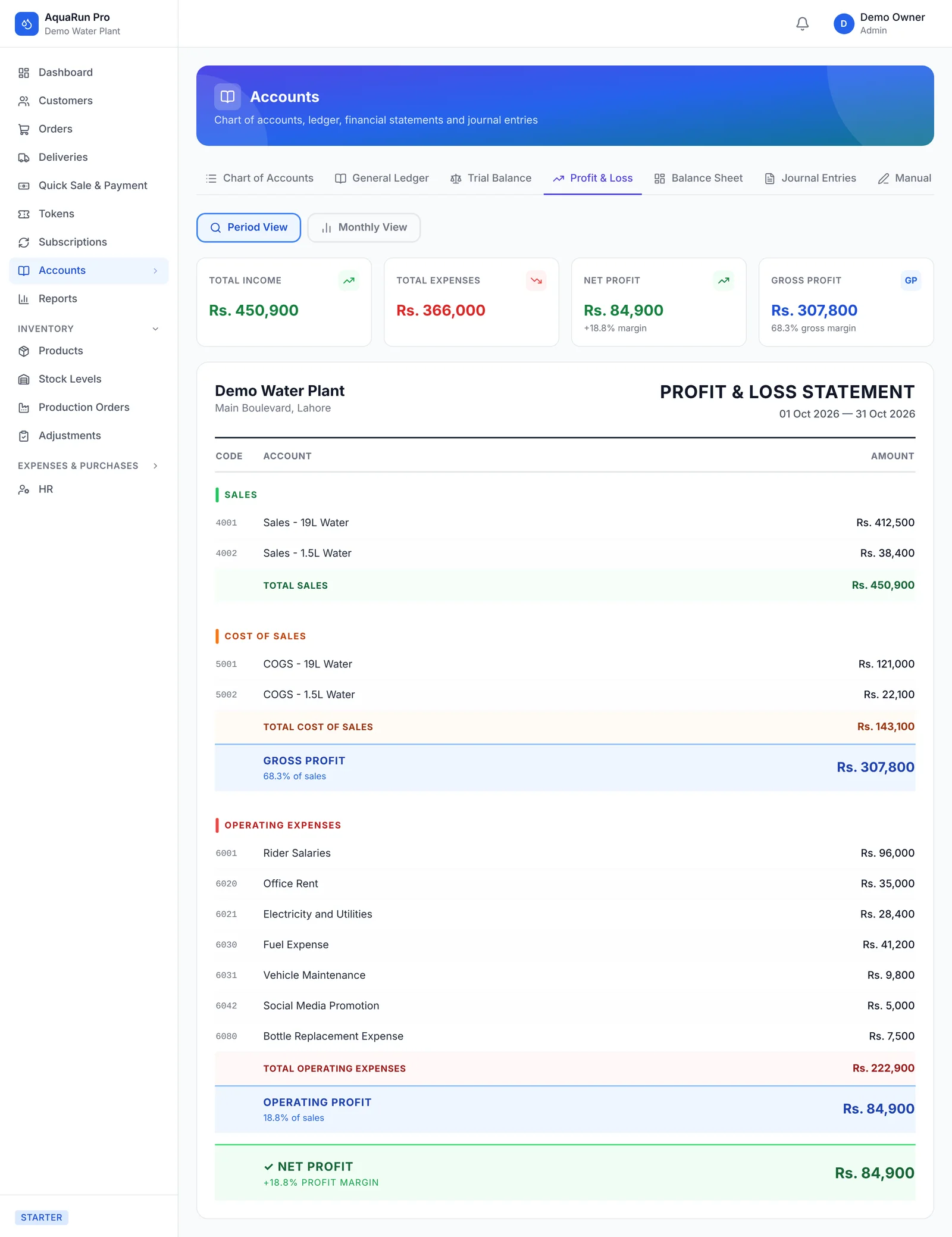
Say a small plant delivers 3,000 bottles of 19 litre water in a month — about 100 a day — at an average of Rs. 90 per bottle. Sales are Rs. 270,000.
The direct cost of filling each bottle is about Rs. 20: caps, seals and labels, washing, filter and membrane wear, and plant electricity. Electricity is a real cost here — as a guide, a plant filling about 2,000 bottles a month may pay around Rs. 15,000 for power, roughly Rs. 7 to 8 per bottle. For 3,000 bottles the direct cost is Rs. 60,000. Gross profit is Rs. 210,000, or Rs. 70 per bottle.
Running costs for the month: one rider and one plant helper Rs. 65,000, fuel Rs. 25,000, vehicle repairs and maintenance Rs. 5,000, rent Rs. 20,000, mobile and marketing Rs. 5,000, and replacement bottles Rs. 6,000. Total Rs. 126,000.
Net profit = Rs. 210,000 − Rs. 126,000 = Rs. 84,000 for the month, or about Rs. 28 per bottle. The same bottle that seemed to earn Rs. 70 really earns about Rs. 28. That is a healthy business — but notice how much of each bottle goes to running the business. We go through this calculation step by step in how much you really earn on one 19 litre bottle.
The break-even point: how many bottles you need
Your running costs (salaries, rent, fuel and so on) have to be paid whether you deliver 1,000 bottles or 5,000. Each bottle pays towards them with its gross profit. So:
Bottles needed to break even each month = monthly running costs ÷ gross profit per bottle.
In the example: Rs. 126,000 ÷ Rs. 70 = 1,800 bottles a month, or about 60 bottles a day. Below that the business loses money; above it, every extra bottle adds about Rs. 70 of profit, because the rider, vehicle and rent are already paid for.
This is why growth on the same routes is so valuable, and why a new plant usually loses money for the first few months while it builds up customers. It also tells you how long your savings need to last before the business pays for itself.
How long until you get your investment back
Payback period = total start-up investment ÷ monthly net profit. With the example profit of Rs. 84,000 a month, every Rs. 1,000,000 invested takes about 12 months to recover — and that is after you reach steady volume, not from the first day.
Be realistic here. Include the months it takes to build up customers, the working capital tied up in bottles at customers and unpaid bills, and a buffer for repairs. Many owners underestimate how much cash a growing water business needs.
The six things that decide profit or loss
- Route density: ten customers in one street cost far less to serve than ten customers across town. Plan routes by area and think twice about single far-away deliveries — a minimum order or delivery charge may be fair.
- Collections (udhaar): a sale is only profit when the money is in your hands. Unpaid balances quietly eat your cash. See recovering unpaid bills.
- Bottle losses: every bottle that is not returned has to be replaced, and one lost bottle can wipe out the real profit of many deliveries. Track bottles per customer and take security deposits.
- Price discipline: a Rs. 10 discount sounds small against Rs. 70 of gross profit, but it removes more than a third of a Rs. 28 real profit. Give discounts on purpose, not by habit.
- Rider cash and stock: cash collected by riders and bottles on the vehicle must be settled every day. Small daily gaps become large monthly losses — see rider cash management.
- Water quality: one bad test or one sick customer can end a water business. A 2025 testing drive by the Khyber Pakhtunkhwa Food Safety & Halal Food Authority found that 63 of 156 bottled water samples failed, almost all because of microbial contamination (KP Food Authority report). Clean bottles, regular testing and proper registration protect your name and your customers.
Local plants vs big brands
Branded water is expensive. A 19 litre Nestlé Pure Life refill costs around Rs. 400 or more in Lahore (Nestlé refill prices), and a 19 litre Aquafina bottle is listed at about Rs. 410 (Aquafina 19 litre). Big brands like Nestlé, Aquafina and Dasani charge for their name and their national advertising. A well-run local plant can sell at a much lower price and still make a profit, because it has lower overheads and delivers within a small area.
That price gap is the opportunity — but customers only switch to a local plant they trust. Consistent quality, on-time delivery, clean bottles and clear, correct bills are what build that trust. Cheap water with poor service rarely lasts.
Seven steps to make your water business profitable
- Know your real cost per bottle: add up a full month of direct costs and running costs — including electricity, filters, bottle replacement and vehicle maintenance — and divide by bottles delivered. Price from this number, not from the competitor's rate.
- Grow on your existing routes first: more customers in the same streets is the cheapest growth there is. Every extra bottle on a route adds almost its full gross profit.
- Collect udhaar every week: set a limit per customer, send statements, and follow up before balances grow. Profit you have not collected is not profit yet.
- Count every bottle: take security on new bottles, record empties returned on every delivery, and follow up customers whose bottle count keeps rising.
- Settle riders daily: cash collected, expenses and bottles on the vehicle should be checked every evening, not at the end of the month.
- Record every expense under a clear heading: fuel, repairs, electricity, salaries, filters, rent. Small costs that are never written down are the ones that quietly eat the margin.
- Use delivery software instead of a register: a register cannot add up your bottles, balances and expenses for you. Water delivery software records each delivery, payment, empty bottle and expense as it happens, and shows your real profit at the end of every month — so the hidden costs become visible. We explain this in detail in the hidden costs of a water delivery business.
Why some water businesses fail
- Pricing from the competitor's rate instead of their own cost per bottle.
- Too much udhaar to too many customers, with balances kept in a register nobody checks.
- Bottles given out without deposits and never counted.
- Spreading across the whole city too early, so fuel and rider time eat the margin.
- No monthly profit and loss — the owner only sees cash in hand, which hides losses until it is too late.
- Cutting corners on water testing and hygiene.
How to know if your business is profitable — every month
The honest answer to "is my water business profitable?" changes every month as fuel, electricity, salaries and customers change. The only way to know is to record every delivery, payment, expense and bottle, and look at a proper profit and loss report each month.
That is what AquaRun water delivery software is built for. Riders record deliveries, cash and empty bottles on their phones; customer balances and bottle counts update by themselves; expenses go into clear categories; and the Profit & Loss report shows sales, gross profit, running costs and net profit for any period. It is free for up to 50 customers, so you can start with proper records from day one — use our checklist for starting a water delivery business alongside it.
Frequently asked questions
- Is the water business profitable in Pakistan?
- Yes, it can be clearly profitable, because demand is daily and customers order again and again. But the real profit per 19 litre bottle is small once riders, fuel, rent and electricity are paid, so profit depends on volume, efficient routes, collecting payments and controlling bottle losses.
- How many bottles do I need to sell to break even?
- Divide your monthly running costs by your gross profit per bottle. For example, Rs. 126,000 of running costs ÷ Rs. 70 gross profit per bottle = 1,800 bottles a month, or about 60 bottles a day. Use your own figures — every business is different.
- How much investment is needed to start a water business?
- It depends on your city, water source and plant size. The main costs are the treatment plant, bottles, a delivery vehicle, the washing and filling setup, and registration and testing. Get written quotations, and keep extra working capital for the first months while you build up customers.
- Are bottle security deposits profit?
- No. A security deposit belongs to the customer and is returned when the bottle comes back. Record it as a liability. Only the sale of water (and any rental or other charges) is income.
- Do I need a licence to sell bottled water?
- Yes. Packaged drinking water in Pakistan is regulated by PSQCA and the provincial food authorities. Requirements change, so confirm the current rules directly with the authorities in your city and province before you start selling.