Profit & accounts
How Much Do You Really Earn on One 19 Litre Bottle? A Simple Profit Calculation for Water Plants
By Muhammad Tanzeel Ur Rehman, CMA · · 6 min read
Ask most water plant owners how much they earn on one 19 litre bottle and the answer comes quickly: "selling price minus filling cost". That number looks healthy, but it is not your profit. Rider salaries, fuel, rent, electricity and lost bottles all come out of the same rupee. This guide shows a simple way to calculate the real profit per bottle from your monthly figures, so you can price correctly and see where money is leaking.
Gross margin is not profit
There are two numbers every water business should know, and they are very different:
- Gross profit per bottle: the selling price minus the direct cost of the water in that bottle (filtration, minerals, cap, seal, label and the filling station cost).
- Net profit per bottle: what is left after you also share out the running costs of the business — riders, fuel, vehicle repairs, rent, electricity, marketing and bottle replacement.
Most pricing mistakes happen because the owner only looks at the first number. A bottle can have a strong gross margin and still make very little once the van, the riders and the rent are paid.
Step 1: Collect one month of real figures
Use a complete month, not a guess. You need four things:
- Bottles sold: the number of 19 litre bottles delivered and billed in the month (not bottles filled).
- Sales: the total billed for those bottles, whether the customer paid or not.
- Direct cost: everything that goes into the bottle itself, from the plant to the cap.
- Operating expenses: salaries, fuel, maintenance, rent, utilities, marketing, bottle replacement and any other running cost.
If you sell other products too, such as 1.5 litre or 0.5 litre packs, keep their sales and direct cost separate. You will share out the running costs between products in step 3.
Step 2: Work out gross profit per bottle
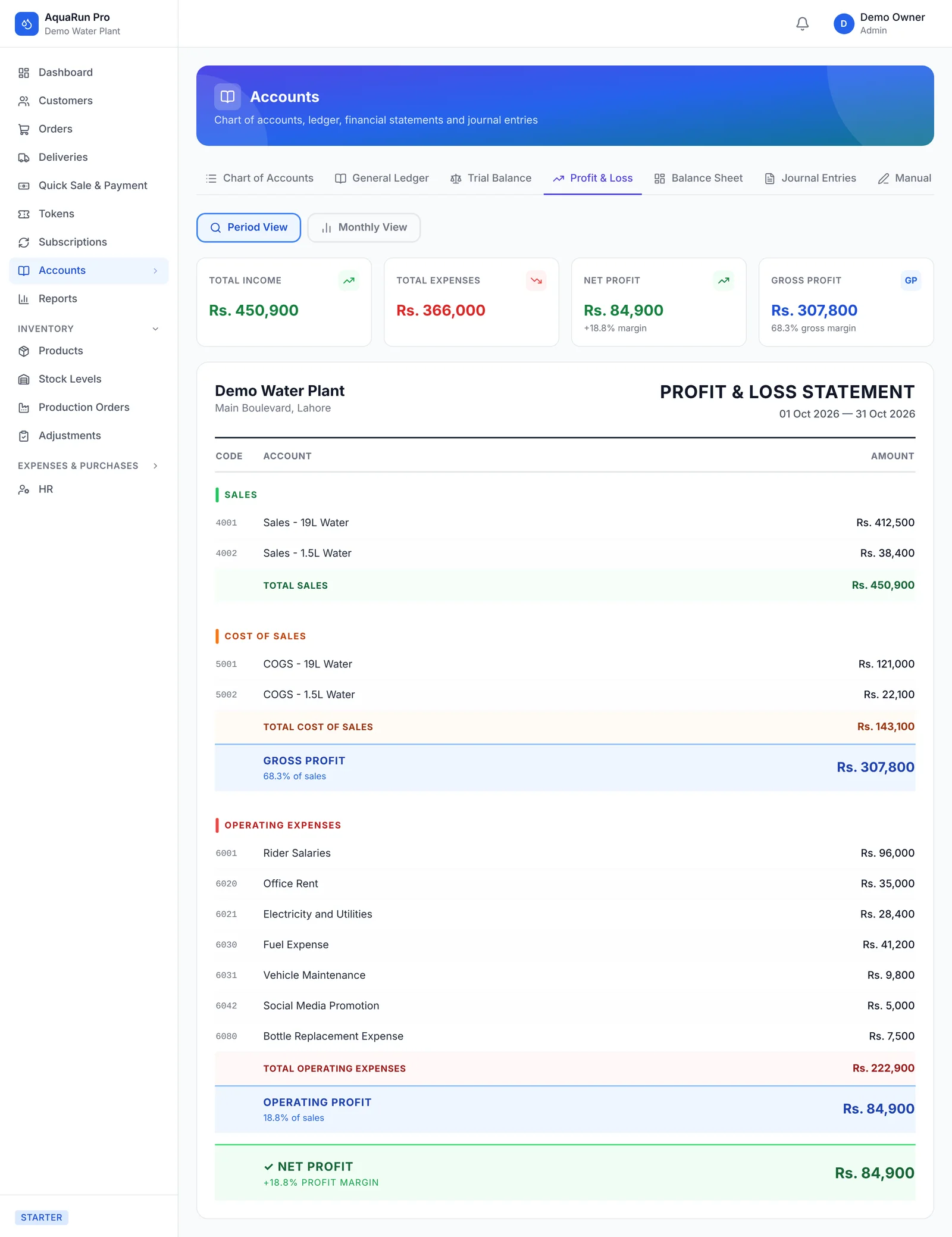
Here is a worked example using demo figures for one month. A plant delivered 5,500 bottles of 19 litre water and billed Rs. 412,500 for them. The direct cost of filling those bottles was Rs. 121,000.
Selling price per bottle = 412,500 ÷ 5,500 = Rs. 75. Direct cost per bottle = 121,000 ÷ 5,500 = Rs. 22. So gross profit is Rs. 53 per bottle. This is the number most owners have in their head.
Step 3: Share out your running costs
In the same month the business spent Rs. 222,900 on operating expenses: rider salaries, rent, electricity, fuel, vehicle maintenance, social media promotion and replacing broken bottles. The plant also sold some 1.5 litre packs, so 19 litre bottles were not the only product carrying these costs.
A simple and fair method is to share running costs by sales. 19 litre bottles were Rs. 412,500 out of Rs. 450,900 total sales, about 91.5%. So their share of operating expenses is about Rs. 203,900, or roughly Rs. 37 per bottle.
Net profit per bottle = 75 − 22 − 37 = about Rs. 16. The same bottle that "earns Rs. 53" really earns about Rs. 16 once the business is paid for. That is still a profitable business, but it changes how you think about discounts, free deliveries and lost bottles.
What this number tells you
Once you know your real profit per bottle, several everyday decisions become easier:
- Discounts: a Rs. 10 discount looks small against Rs. 53, but it takes away a large part of a Rs. 16 profit.
- Lost bottles: when a bottle is not returned, you lose its replacement cost. Covering it takes the profit from many full deliveries — which is why bottle and deposit tracking matters so much.
- Far-away customers: a single bottle to a distant area uses fuel and rider time. You may decide on a minimum order or a delivery charge for some areas.
- Price increases: when fuel or electricity goes up, you can see exactly how much it moves your cost per bottle and decide your new rate with numbers, not guesswork.
- Udhaar: profit is only real when it is collected. Keep an eye on unpaid bills with the steps in our guide to recovering unpaid bills.
Do this every month, not once
Costs move every month: a vehicle repair, a new rider, a higher electricity bill. Repeat the calculation every month and compare it with the previous one. If the profit per bottle falls, look at which expense grew.
This is much easier when every sale and expense is already in proper accounts. In AquaRun, deliveries post to sales and cost of sales automatically, and expenses are recorded under clear categories such as fuel, rent and rider salaries. The Profit & Loss report then shows sales, gross profit, operating expenses and net profit for any period, and a Monthly View puts months side by side so you can spot changes quickly. It is free for up to 50 customers.
Frequently asked questions
- What should I include in the direct cost of a 19 litre bottle?
- Include everything that goes into filling and sealing the bottle: water treatment and filtration, minerals, caps, seals, labels and the running cost of the filling station. Keep salaries, fuel, rent and marketing out of direct cost; they are operating expenses and are shared out in step 3.
- How should I share running costs if I sell several products?
- Sharing by sales value is the simplest fair method for a small business. If one product clearly uses more delivery effort, for example heavy 19 litre bottles versus small packs, you can share delivery costs such as fuel and rider salaries by the number of deliveries instead.