LPG delivery
LPG Cylinder Delivery Business in Pakistan: How to Track Cylinders, Refills and Deposits
By Muhammad Tanzeel Ur Rehman, CMA · · 5 min read
In an LPG delivery business, the gas is only half of what you sell. The other half is the cylinder — an expensive asset that leaves your shop full and is supposed to come back empty. Restaurants, hostels and homes may hold several of your cylinders at once, some with a deposit and some without. When nobody knows exactly where every cylinder is, money disappears quietly. This guide shows a simple system to track cylinders, refills and deposits, customer by customer.
Why cylinders go missing
Cylinder losses rarely come from one big event. They build up from small gaps that repeat every day:
- A refill is delivered but the empty cylinder is "collected next time", and next time never comes.
- A new customer gets a cylinder without a deposit because the rider wanted to close the sale quickly.
- Commercial customers with several cylinders swap them between branches, and your record shows the wrong place.
- Deposits are taken in cash and never written against the customer, so the refund later becomes an argument.
- A customer stops ordering, but their cylinders stay with them for months.
Record every cylinder movement, every time
The rule is simple: every time a cylinder goes out or comes back, it is recorded against that customer on the same day. For each delivery, the rider should record:
- How many full cylinders were delivered, and of which size (for example 11 kg or 45 kg).
- How many empty cylinders were collected back.
- Any new cylinder placed with the customer, and the deposit taken for it.
- Cash or digital payment received for the refill.
With these four facts, the number of cylinders at each customer is always "delivered minus returned". You no longer need to count from memory or go door to door at the end of the year.
Treat deposits as the customer's money
A cylinder security deposit is not income. It belongs to the customer and must be returned when they give back the cylinder. Record it as a liability — money you owe — not as sales. This keeps your profit honest and makes refunds easy, because you can see exactly how much each customer paid.
Decide your deposit policy once and apply it to every new customer: which cylinder sizes need a deposit, how it is refunded, and what happens if a cylinder is damaged. The same principles we explain for 19 litre water bottle deposits apply to cylinders, with even more money at stake per unit.
Review cylinders with customers every week
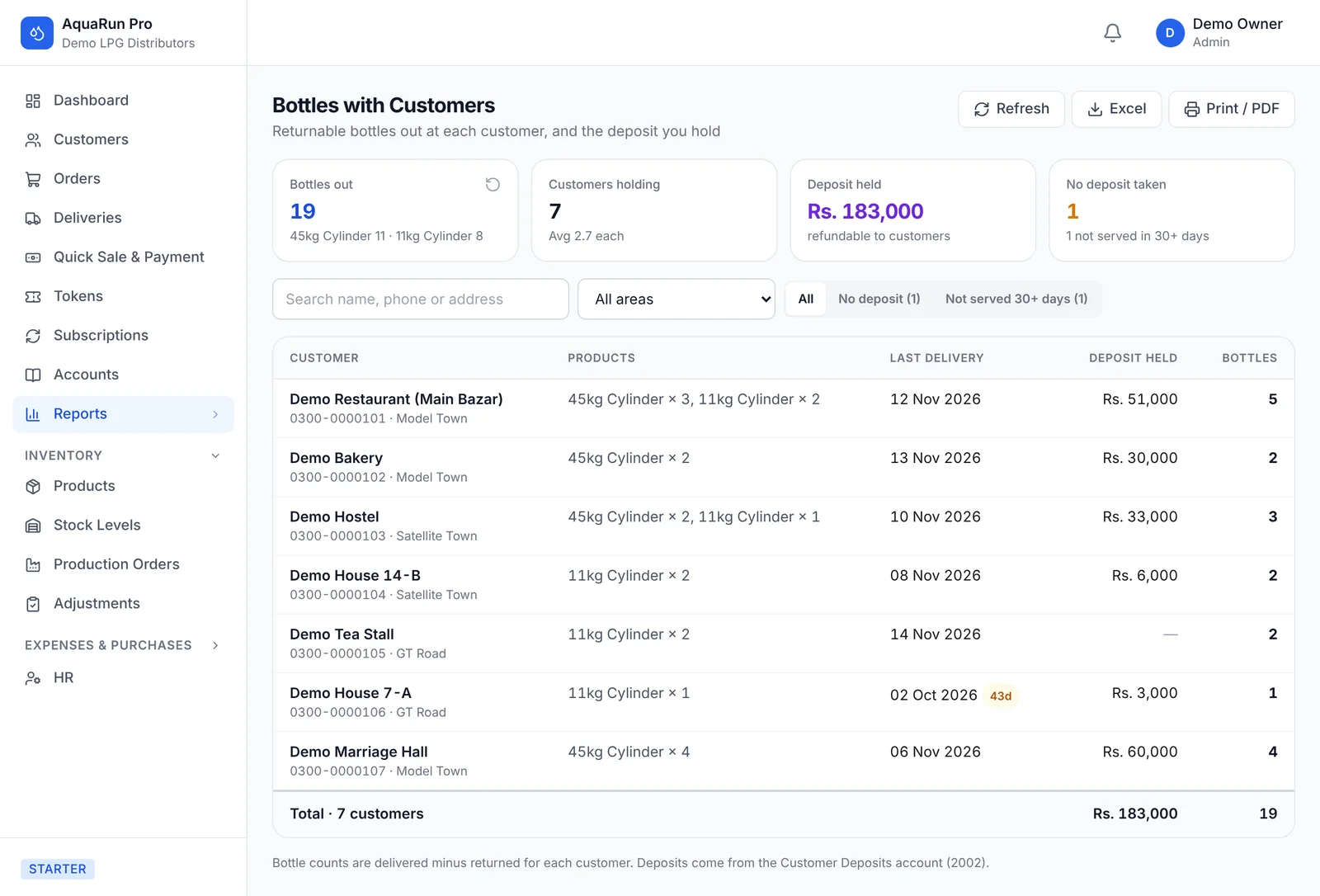
Once a week, look at a simple list: every customer, the cylinders they hold, the deposit held, and the date of their last refill. Three things deserve attention:
- Customers holding cylinders with no deposit — decide whether to collect one or take the cylinder back.
- Customers who have not ordered in 30 days or more — call them before the cylinders are lost.
- Commercial customers holding many more cylinders than they use in a week — they may be keeping your stock idle.
Keep rider cash and stock in balance
LPG riders usually carry both cylinders and cash. At the end of each day, the cylinders loaded on the vehicle should match the cylinders delivered, collected and brought back, and the cash should match the refills sold. The daily settlement routine in our article on rider cash management works the same way for gas: settle every rider every day and raise any shortage the same day.
For safety and compliance, make sure your storage, vehicles and licensing meet current requirements. Confirm them with OGRA and your local authorities, as rules can change.
Use software built for returnable containers
General billing software counts sales, but it does not know that a cylinder is still out with a customer. AquaRun was built for businesses with returnable containers — water bottles, milk containers and gas cylinders. Riders record refills, empties collected and payments on their phone, even without internet. Each customer's cylinder count and deposit update automatically, and the Bottle Tracking report shows the full list with deposit held and customers not served in 30+ days, ready to export to Excel.
Deposits are kept in a separate customer deposits account, and stock is valued at weighted average cost, so your accounts stay correct. See the LPG delivery software page for details — it is free for up to 50 customers.
Frequently asked questions
- Should a cylinder deposit be shown as income?
- No. A security deposit is refundable, so it is a liability: money you hold on behalf of the customer. Only refill sales and cylinder sales are income. If a deposit is forfeited, for example for a lost cylinder under your written policy, that amount can then be recognised as income.
- How often should I check how many cylinders each customer holds?
- Weekly is a good rhythm for most LPG businesses. Focus on customers with no deposit and customers who have not ordered in 30 days or more, as those are where cylinders are most often lost.